
Table of Contents
- How Spending Time in Nature Deepens Spiritual Awareness
- Mindfulness in Nature: Starting Where You Are
- Nature Meditation for Beginners: A Simple Foundation
- Grounding and Connection: Feeling Earth Beneath You
- How Long Should I Spend in Nature for Spiritual Growth
- Nature Walk Reflection Prompts to Deepen Your Practice
- Common Mistakes to Avoid When Seeking Spiritual Connection Outdoors
- Frequently Asked Questions
Last Updated: October 21, 2026
How Spending Time in Nature Deepens Spiritual Awareness
The shift from noise to presence is where everything changes. When you step outside and leave behind the hum of devices, conversations, and constant demands, something settles. Your mind finds space it didn’t know it was missing. This is where spending time in nature spiritual awareness begins, not through effort, but through permission.
At Twin Featherz, I work with people seeking clarity and connection. Nature has a way of opening us.
What spiritual awareness actually means is becoming conscious of the subtle dimensions of existence beyond the material. It’s noticing the energy that moves through all living things, recognising synchronicity, feeling connected to something greater than yourself. For some, this connection is deeply personal and intuitive.
Spending time in nature spiritual awareness deepens because the natural world speaks in a language older than thought. Trees, water, earth, and sky don’t demand your attention, they invite it. When you accept that invitation, your ordinary awareness shifts into something more receptive.
Mindfulness in Nature: Starting Where You Are
Mindfulness in nature isn’t about achieving a perfect meditative state. It’s about noticing what’s actually here, right now, without judgment or agenda. Many people believe they need to travel to a pristine wilderness or find the “right” location. The truth is simpler: spiritual awareness deepens wherever you are willing to pay attention.
Slowing Down Your Senses
Start by choosing one sense to focus on. Not all of them at once, that overwhelms. Pick one.
If you choose sight, notice three things around you. Not their names or categories. Their actual appearance. The way light falls on a leaf. The texture of bark. The movement of clouds. Don’t think about what you’re seeing. Just see it.
If you choose sound, listen for layers. The obvious sounds first: birds, wind, traffic. Then the quieter ones beneath them. A rustle. A distant hum. Silence itself has texture.
If you choose touch, feel the ground beneath you. Grass, soil, stone, concrete, whatever is there. Notice temperature. Texture. Whether it feels solid or yielding. Your body is in constant contact with the earth. Most of the time, you’re not aware of it.
Smell and taste work the same way. Pick one. Notice it fully. Don’t rush.
This is where present-moment awareness outdoors begins. Not through force. Through genuine curiosity about what’s actually present.
Choose one sense per visit. Master noticing through that sense before adding another. Your attention becomes sharper each time you practise.
Present-Moment Awareness Outdoors
The mind naturally wanders. That’s not failure, that’s how minds work. Present-moment awareness outdoors isn’t about stopping thoughts. It’s about noticing when you’ve drifted and gently returning.
You’re sitting by a tree. Your attention is on the texture of the bark. Then your mind jumps to a conversation from yesterday. That’s fine. Notice it happened. Bring your attention back to the bark. That’s the whole practice.
Most people expect this to feel peaceful immediately. Sometimes it does. Sometimes it feels restless or boring at first. Both are normal. Your nervous system is learning a new way of paying attention. That takes time.
The shift happens gradually. After a few visits, you notice you’re drifting less often. Your body feels heavier, more grounded. Your breathing slows without you trying to slow it. These are signs that your awareness is genuinely settling into the present moment.
Nature Meditation for Beginners: A Simple Foundation
Meditation in natural settings doesn’t require special training or equipment. It requires only your willingness to sit quietly and notice what happens.
What You’ll Need Before You Start
- A place where you can sit undisturbed for 10-15 minutes
- Comfortable clothing appropriate to the weather
- No phone, watch, or timer you need to check
- A spot where you feel safe and reasonably private
- Willingness to sit with whatever arises, boredom, restlessness, peace, emotion
That’s genuinely all you need. You don’t need perfect conditions. You don’t need to be in a forest. A park bench works. A quiet garden works. Your backyard works.
Your First Nature Meditation
Sit comfortably. Your spine can be upright or relaxed, whatever feels sustainable for 10 minutes.
Close your eyes or keep them softly open, gazing downward. Choose whichever feels natural.
Notice your breathing. Don’t change it. Just observe it. In and out. That’s your anchor point.
When your mind wanders, and it will, notice where it went. Don’t judge yourself. Gently return to the breath.
Do this for 10 minutes. That’s the whole meditation.
If your mind feels particularly busy on your first attempt, that’s completely normal. Your awareness is learning to settle. Some days it settles quickly. Some days it takes the full 10 minutes. Both are progress.
After your meditation, sit quietly for another minute or two before standing. Notice how your body feels. Notice the quality of your awareness. This noticing is part of the practice.
Nature meditation deepens with repetition, not intensity. Ten minutes twice a week is more valuable than one hour once a month.
Grounding and Connection: Feeling Earth Beneath You
Grounding is a spiritual practice with a physical dimension. It’s the deliberate choice to connect your body with the earth beneath you and, through that connection, to feel your place in the larger web of life.
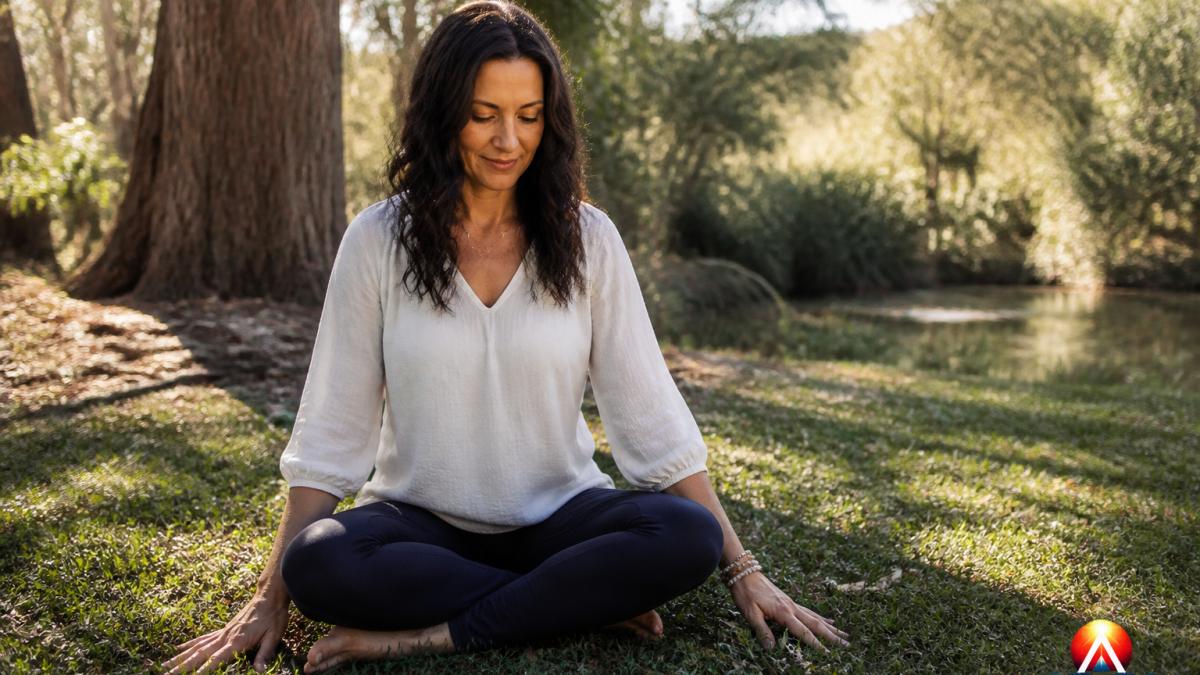
Many spiritual traditions recognise this. Barefoot walking, sitting directly on soil or grass, placing your hands on tree bark, these aren’t superstition. They’re ways of acknowledging that you’re not separate from the natural world.
When you sit on the earth or walk barefoot, something shifts in your nervous system. Your awareness changes. Time feels different. The constant low-level tension many people carry begins to release.
Try this: Sit on bare ground or grass. Place your palms flat on the earth. Feel the contact. Don’t do anything special. Just notice that you’re touching something alive. That you’re held by it. That you belong here.
This is grounding. It’s simple. It’s also profound. The more you practise it, the more you recognise this connection isn’t something you create, it’s something you remember.
How Long Should I Spend in Nature for Spiritual Growth
There’s no magic number. Some people experience profound shifts in 15 minutes. Others need longer. The question isn’t “How much time is enough?” It’s “What time can I actually commit to?”
Consistency matters far more than duration. Twenty minutes twice a week, sustained over months, will deepen your spiritual awareness more than one four-hour visit and then nothing.
Start with what feels manageable. Fifteen minutes is enough to quiet your mind and feel the shift. Thirty minutes allows for deeper settling. An hour gives your awareness time to expand and integrate the experience.
The real measure isn’t the clock. It’s whether you feel different after. More present. More connected. Clearer. If you do, you’ve spent enough time. If you don’t, you might need a bit longer, or you might need to visit more often.
The shifts you’ll notice can become stable over time. You may carry that sense of connection into your daily life, even when you’re not in nature.
Forcing yourself to stay longer than feels right creates resistance, not openness. Spiritual awareness deepens through gentle consistency, not through pushing.
Nature Walk Reflection Prompts to Deepen Your Practice
Walking in nature is meditation in motion. But without reflection, you might miss the insights that arrive during or after the walk. These prompts help you anchor and integrate what you experience.
Before You Walk: Setting Your Intention
An intention isn’t a goal. It’s a quality you invite into the experience. Before you step outside, pause and ask yourself one of these:
- What do I need to understand right now?
- What part of myself am I ready to see more clearly?
- What quality do I want to cultivate, peace, clarity, courage, openness?
- What am I carrying that I’d like to release?
Don’t overthink this. The first answer that arrives is usually the right one. Hold it lightly as you walk. You’re not trying to make anything happen. You’re simply walking with an open question.
During Your Walk: Observation and Noticing
As you walk, notice what catches your attention. Not what you think should catch your attention, what actually does.
A particular tree. A pattern of light. A bird. A sound. A feeling that arises. These aren’t random. They’re invitations.
When something captures your awareness, pause. Look at it fully. Feel into it. What does it evoke in you? What does it remind you of? What might it be reflecting back to you about your own inner state?
You don’t need to understand this intellectually. The insight might arrive as a feeling, an image, or simply a knowing. Trust what arrives.
After Your Walk: Journalling and Integration
Within an hour of your walk, write about your experience. Not a formal account. Just what stood out. What you noticed. What you felt. What insights arrived.
Write without editing yourself. Let the words come as they come. You’re not creating something to be read. You’re anchoring the experience in your awareness.
After a few weeks of this practice, patterns emerge. You notice recurring themes, symbols, or insights. These patterns are your inner wisdom speaking to you through nature. This is where spending time in nature spiritual awareness becomes genuinely transformative, when you integrate what you experience and allow it to inform how you live.
Common Mistakes to Avoid When Seeking Spiritual Connection Outdoors
Expecting immediate transcendence. Spiritual awareness deepens gradually. If you spend 20 minutes in nature and feel nothing special, that doesn’t mean it didn’t work.
Forcing the experience. Trying too hard to feel spiritual, to have an insight, or to achieve a particular state creates tension.
Comparing your experience to others. Someone else’s profound vision in nature doesn’t mean you’re doing it wrong if your experience is subtle.
Staying in your head. Analysing your experience while you’re having it interrupts it. Save the thinking for later.
Neglecting the follow-up. The walk is only half the practice. The reflection, journalling, and integration are where the real deepening happens.
Waiting for perfect conditions. You don’t need sunshine, solitude, or a scenic location. You need a place where you can be present.
Spending time in nature spiritual awareness isn’t a destination you reach. It’s a practice you return to, again and again.
The shifts you’ll notice aren’t just spiritual. Your mind becomes clearer. Your emotions settle. Your body feels more at home in itself.
Frequently Asked Questions
How can spending time in nature deepen spiritual awareness?
Nature slows your mind and quiets mental chatter, creating space for spiritual perception. When you step away from constant stimulation, you become more receptive to subtle feelings, intuitive impressions and a sense of connection to something larger than yourself. Regular time outdoors strengthens your ability to notice synchronicity, sense energy shifts and feel grounded in your own spiritual experience rather than living entirely in your thinking mind.
What’s a realistic timeframe to see spiritual shifts from nature practice?
Even 15 to 20 minutes of mindful time outdoors can shift your awareness, though consistency matters more than duration. Some people notice changes within a week of regular practice; others take several weeks. The key is showing up repeatedly rather than occasional long visits. Starting with whatever time feels sustainable, a short walk, sitting by a tree, or time in a garden, builds the foundation. Over time, you’ll develop sensitivity to subtle changes in your own energy and perception.
Can nature help me feel more connected to my intuition?
Yes. Intuition often gets drowned out by mental noise and everyday stress. Nature quiets that noise, making it easier to hear your inner knowing. When you’re grounded outdoors and present with your senses, you become more aware of feelings, hunches and impressions that usually go unnoticed. This strengthened connection to your intuition can carry into other areas of your life, helping you make clearer decisions and trust your inner guidance more fully.
What if I live in an urban area or have limited mobility, can I still deepen spiritual awareness through nature?
Absolutely. Spiritual connection isn’t about location or fitness level. A small park, a balcony with plants, a window view of trees, or even time with potted plants indoors can serve as your nature practice. What matters is your intention and presence, not the scale of the landscape. Adapt your practice to what’s accessible to you, a short walk, sitting on a bench, observing birds or clouds, or simply breathing in fresh air. Consistency and genuine presence will deepen your awareness regardless of your circumstances.